
Guides
Putting On a Show in London: Budget Lines for Venue, Insurance and Licenses
Putting on a show in London? Here are the budget lines a conference organizer must carry: venue hire, insurance cover, music licenses and safety duties.
Putting on a show in London — an awards ceremony, a product launch, or a general session with a full stage set — adds three budget layers to a conference plan that a US organizer may not carry at home: London venue hire and the charges that surround it, the insurance the venue contract requires, and the music and rights fees a live show attracts. This article walks through each layer as named budget lines, lists the documents that back them, and sets out what to settle before you sign. Rates come from written quotes; what this guide fixes is which lines belong in the budget, and who owns each one.
What a show in London adds to a conference budget
A US conference budget usually turns on facility rental, catering, audiovisual, labor and tax. Staging a show in London keeps those lines but gives them a production shape: the room is also a licensed performance space with a technical schedule, a box office, and its own licensing and insurance requirements.
Three layers sit on top of the standard conference plan. First, the venue: not the hire fee alone, but the days, staff, power, ticketing and deposits written into the hire agreement. Second, insurance: the cover the venue asks to see, plus the cover the law requires you to hold as an employer. Third, fees: the music and rights licenses a show with live or recorded music needs, and the permissions a scripted work needs.
Two more layers follow those through the invoice file. Tax attaches to venue and service invoices, and health and safety duties attach to the build and the get-in. Both are small in cash terms and expensive to get wrong, because a missing document can stop an access time.
Nothing here quotes a market rate. Venue hire, insurance premiums and license fees are quoted per venue, per production and per run, so the discipline that pays is completeness: make sure every line below appears in your budget, and tie every figure in it to a written quote.
London venue hire: the budget lines inside and outside the contract
Venue hire is the largest single line in a show budget and the one with the most surrounding charges. A quote for "the room" is a starting point, not a budget.
How a London venue structures its hire fee
Three structures are common, and the quote should say which one you are being offered.
- A fixed hire feefor a defined period. You pay for the space, run the show and take the ticket income.
- A four-wall deal.You pay a fixed fee and keep the ticket income, which means you carry the entire box office risk if the show does not sell.
- A profit or revenue share.The venue takes an agreed share after defined costs, instead of or as well as a hire fee. The definition of those costs matters more than the share itself.
Some London venues also take a commission on ticket sales on top of the hire fee, usually through their own box office. Ask whether the commission applies to all sales or only to sales through the venue, and how any outside ticketing platform's fees are treated.
Charges that sit outside the hire fee
These are the lines where a venue budget usually slips:
- Get-in and get-out days, charged at the performance-day rate or at a separate technical rate.
- Front of house and security staffing, billed by the hour or by the shift, often with a minimum call.
- Cleaning and waste removal, which may be deducted from the deposit after the run.
- Power, rigging points and house technical crew.Some venues include a technician in the hire; most bill additional hours separately.
- Box office and card processing fees, plus any charge for using a ticketing platform other than the venue's.
- Catering and bar commission, and any minimum spend attached to the room.
- Deposits and cancellation termswhat is refundable, what is lost on postponement, and how close to the date those terms change.
What to settle before you sign
- The technical scheduleload-in window, get-in days, get-out deadline and any overnight access.
- The licensed capacity and how it is counted for seated and standing configurations.
- Curfew and noise limits, which in London can end a show earlier than the program expects.
- Exclusivitywhether another event can share the building or the foyer during your access days.
- Whether the hire quote is inclusive or exclusive of VAT, and whether VAT applies to every charge in the schedule.
- The insurance the venue requiresthe certificate, the limits, and whether the venue must be named as an additional insured.
Insurance lines a London venue will ask you to carry
Production insurance is the second layer. Three covers matter most, and one of them is a legal duty rather than a contractual preference.
The cover the contract names
- Public liabilitycovers injury to third parties and damage to their property. Almost every London venue makes it a condition of hire, sets a required limit in the contract, and asks for evidence before the get-in. The public liability cover you already hold for US events may need a territorial extension to respond in the UK.
- Cancellation and abandonmentcover protects the income you lose if a performance cannot go on. Insurers rate it on the insured value — effectively the box office you expect to take — so the quote depends on your own sales forecast, on the health questions the insurer asks about the cast, and on the venue's exposure.
- Equipment coverfollows the production kit in transit and on site, from the truck to the stage floor.
- Personal accident coverfor performers and crew, and, for larger companies, directors' and officers' liability, are worth pricing alongside the three core covers.
Employers' liability is a legal duty
If you employ people in the UK, the Employers' Liability (Compulsory Insurance) Act 1969 requires you to hold employers' liability insurance with an authorized insurer, and to make the certificate available to employees. It is not something a venue can waive for you, and it is separate from the public liability cover named in the hire contract. Where you engage crew through a UK production company or a payroll provider, agree in writing who carries the employers' liability cover for those people before the first day on site.
Premiums are rated on the information you give the insurer — payroll, attendance, insured value, run length and the condition of the venue — so the number moves when the plan moves. Two practical points for the budget: premiums for general insurance in the UK normally include Insurance Premium Tax, which is not VAT and should not be reclaimed as VAT; and a certificate that is dated, current and names the correct production company is the document the venue's production manager will actually ask to see.
Documents to collect before the get-in
- The certificate of insurance for public liability, with the venue named as required.
- The employers' liability certificate from an authorized insurer.
- The cancellation policy schedule, showing the insured value and what would trigger a claim.
- Equipment cover confirmation listing the high-value items.
Music and rights fees: PRS for Music, PPL and TheMusicLicence
Music licensing is the layer most often missing from a first budget, because the venue usually holds some license of its own and the assumption is that it covers the show.
What each license covers
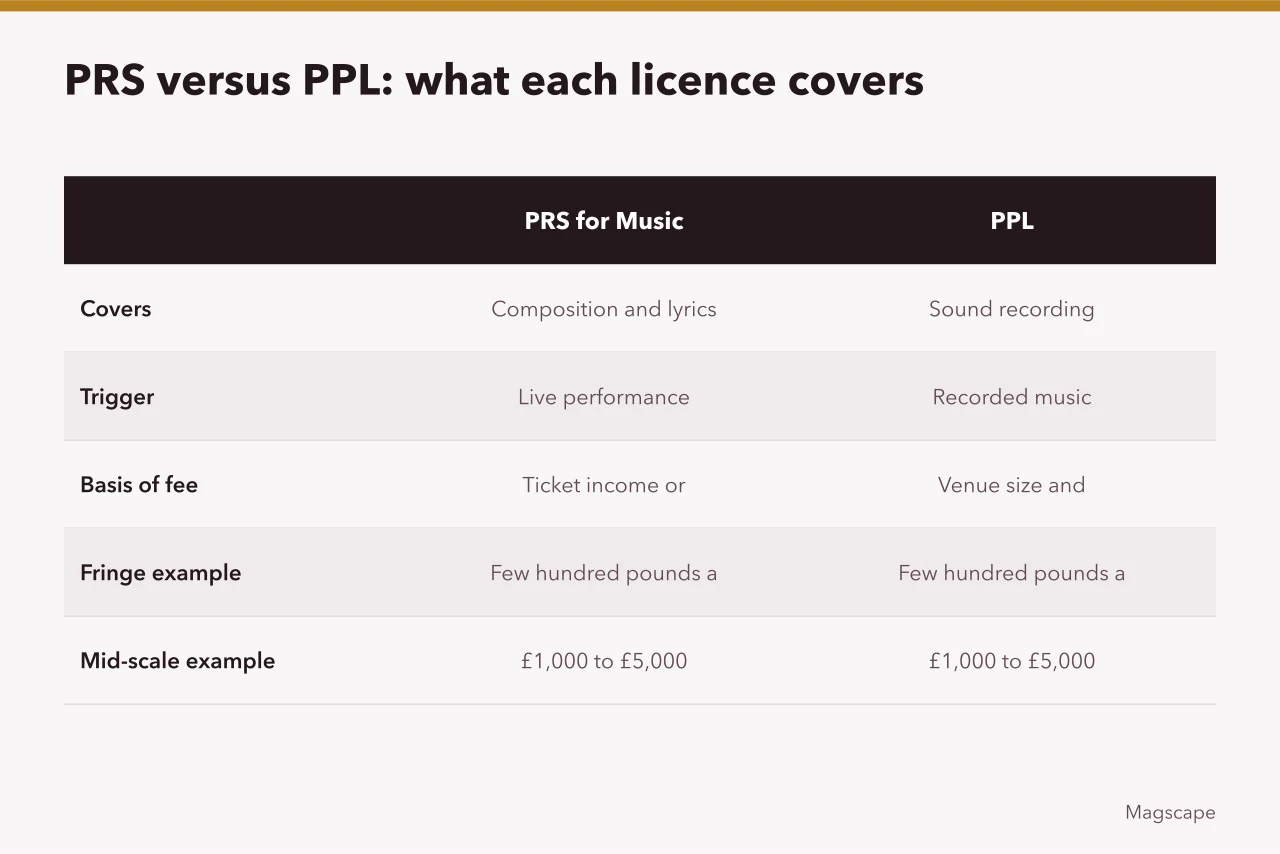
Two organizations license music in the UK, and they cover different rights:
- PRS for Musiclicenses the public performance of musical works — the composition and the lyrics.
- PPLlicenses the use of recorded music — the sound recording itself.
PPL PRS Ltd, the joint company owned by the two organizations, issues TheMusicLicence for playing music in public premises. Many London venues hold a TheMusicLicence for background, walk-in and interval music, which is why a venue can say, truthfully, that it is licensed. That license does not usually extend to a production that features music in its own right, such as a live band, a headline performance or a recorded soundtrack that is part of the show. The production license is arranged separately, and the person responsible for it should be named in the contract.
Grand rights, commissioned music and permission
A scripted work with music — a musical, an opera, a revue built on existing songs — needs permission from the rights holder as well as a performance license. That permission is normally arranged through the publisher or the show's licensing agent, and it is separate from both PRS and PPL. If the show commissions original music, the composer and lyricist agreements are separate again, and they should say what the fee buys: the performance, the recording, the filming, or all three.
What to put in the budget
- A named line for each licensePRS for Music, PPL, and any grand rights permission.
- The musical content lista cue sheet naming each work, its writer and publisher, and whether it is live or recorded — so the license can be quoted from facts rather than estimates.
- An application lead time that runs back from the first rehearsal, not the first performance.
- The name of the person who owns the license applications, written into the production schedule. Our conference budget template has a place for that owner beside each line.
Tax lines that arrive with the venue and fee invoices
Tax is not a venue charge or an insurance charge, but it changes how both quotes compare, so it belongs in the same budget review.
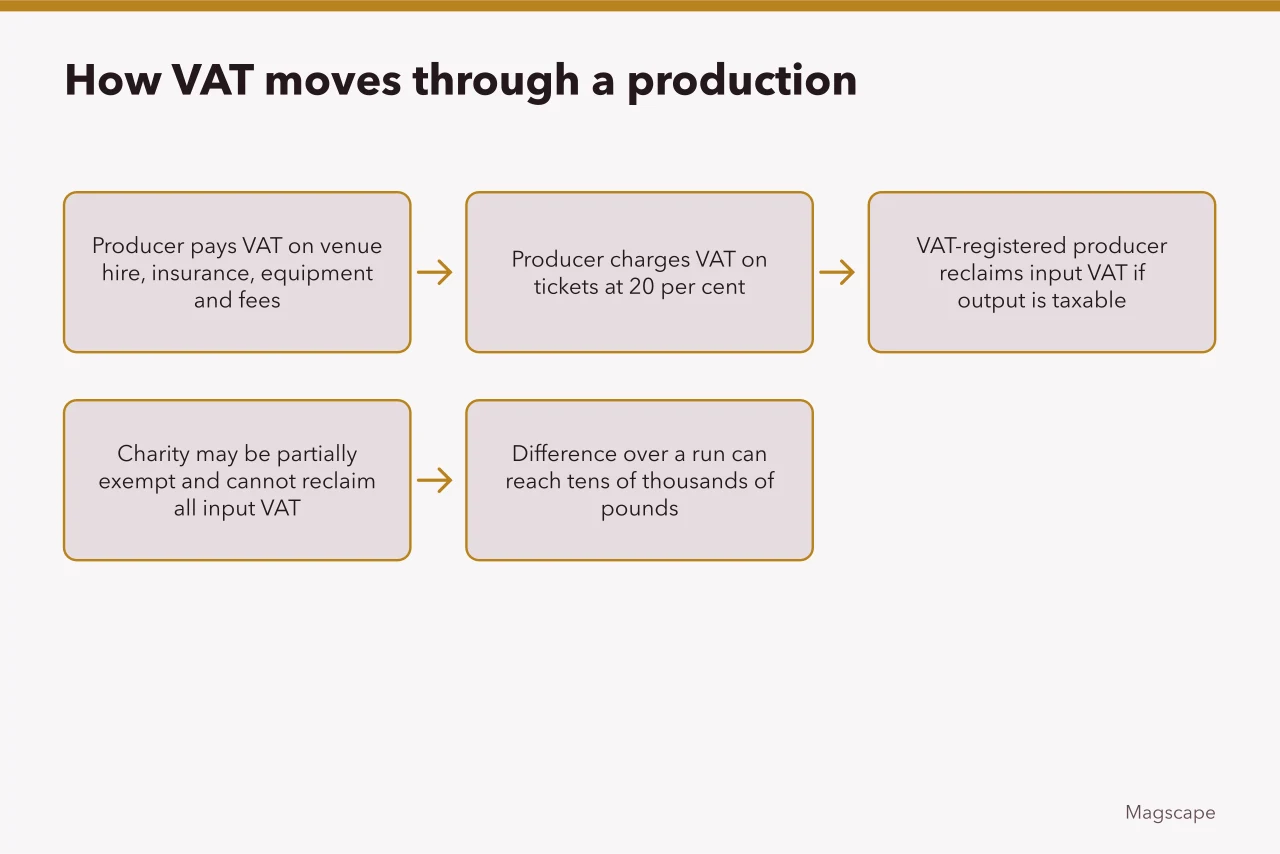
UK venue hire, production services and most commercial ticket sales are subject to VAT. Venue quotes are often given exclusive of VAT and some are not, so write the VAT status next to each line before you compare them. Whether your business can recover the VAT on those invoices depends on your registration and on the supplies you make, so take advice for the entity that signs the contract rather than assuming the treatment a US company gets at home.
Insurance premiums are treated differently: general insurance in the UK carries Insurance Premium Tax, normally included in the premium quoted, and it is not recoverable as VAT. Music licenses are issued under their own tariffs and their own VAT treatment, which the licensor will confirm on the application.
If you are paying a London contract from a US budget, the invoice currency is part of the tax question, not separate from it. Our guide to budgeting a UK conference from the US covers the currency and registration steps that sit on either side of these invoices.
Health and safety duties that carry cost
Health and safety is the fifth layer and the least negotiable. The Health and Safety at Work etc. Act 1974 places duties on employers to protect their employees and others affected by the work, and the Health and Safety Executive enforces them in venues and on production sites. For a producer, those duties arrive as documents that must exist before access is granted.
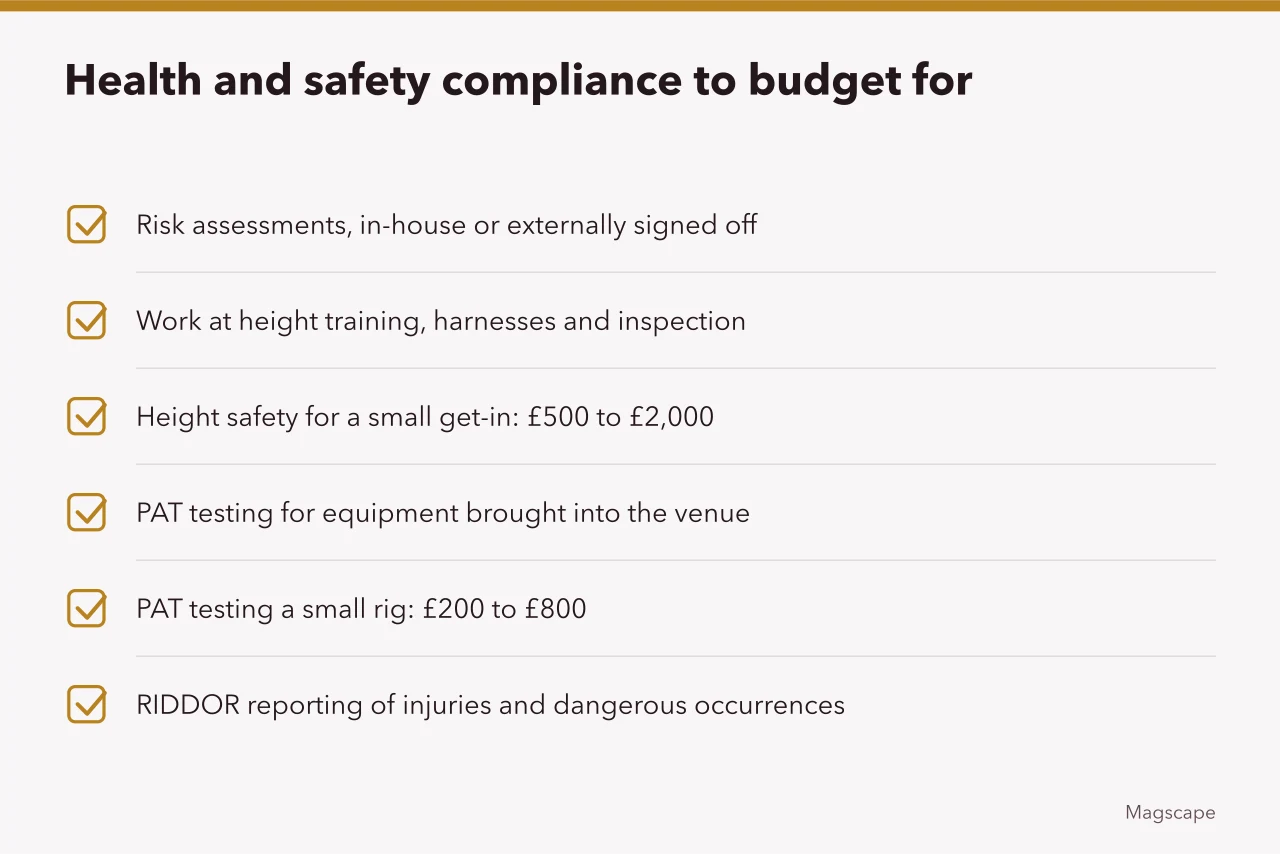
The Work at Height Regulations 2005 apply to rigging, truss building, focusing at height and the get-in. They cover any place where, without precautions, a person could fall a distance liable to cause personal injury, which takes in more of a conference stage build than most organizers expect. See Working at height for the HSE guidance.
Other duties that turn into budget lines:
- Risk assessmentsfor the build, the get-in and the show itself, required of every employer under the Management of Health and Safety at Work Regulations 1999.
- Electrical safetythe Electricity at Work Regulations 1989 require electrical equipment to be maintained so that it is safe, and London venues commonly ask for testing records before equipment is connected. There is no general legal requirement to test every portable appliance on a fixed calendar; the requirement is that the equipment is safe and that you can show how you know.
- Fire safetyunder the Regulatory Reform (Fire Safety) Order 2005, the responsible person for the premises must carry out a fire risk assessment. The venue usually holds the building's assessment, but production elements such as set, drapes, pyrotechnics and temporary lighting positions can change it, so the review belongs in your production schedule.
- First aid coverfor rehearsals, the get-in and performances.
Budget lines here are training, harness and lifting equipment inspection, electrical testing, a fire risk assessment review, and first aid provision. The cash is small beside venue hire; the risk is schedule. If a harness inspection or a testing record is missing on the day, access stops, and the get-in that was budgeted for one shift takes two.
The budget-document checklist for a London show
Use the table as the review sheet before you sign a hire agreement and again before the get-in. Every line should have an owner and a document.
| Layer | Budget lines | Document to hold |
|---|---|---|
| Venue | Hire fee or revenue share, get-in and get-out days, box office commission, front of house and security staffing, cleaning, power and house crew, deposits | Signed hire agreement with the technical schedule and the charging schedule |
| Insurance | Public liability, employers' liability, cancellation and abandonment, equipment, personal accident | Certificate of insurance; employers' liability certificate from an authorized insurer |
| Music and rights | PRS for Music license, PPL license, grand rights permission, composer and lyricist agreements | Written license or permission covering the run; music cue sheet |
| Tax | VAT on venue and production services, Insurance Premium Tax on premiums | VAT invoices and the VAT status of each quote |
| Health and safety | Risk assessments, work at height training and equipment inspection, electrical testing, fire risk assessment review, first aid | Risk assessments, inspection and test records, fire risk assessment |
For the US side of the same table — the compliance lines you carry when the show sits in an American convention center — see OSHA and ADA compliance costs.