Guides
Conference Organizer Budgets: Software Pricing Models
Conference organizer budgets treat registration, badging and event software as line items shaped by pricing model, labor, variance and the final invoice.
What to take away
- Conference organizer budgets carry registration, badging and event software as line items that move with attendance.
- The pricing model sets the riska quote, a per-ticket fee, a per-event charge or a per-seat license.
- Variance surfaces at the close, when fees, modules and headcount meet the real bill.
- The line goes quiet once the final invoice clears the accrual and the variance note is filed.
Where registration and badging enter the estimate
The first estimate splits event software into platform fees and the labor to run it.
Public ticketing charges per ticket, while a quote-based suite arrives as an annual contract. The conference organizer budget stages show where each one lands in the estimate, the approval memo and the actuals.
Badging straddles both. Printing hardware and badge stock are consumables, while the software that prints the badges usually rides inside the registration contract.
Pricing models and what each one does to a forecast
Pricing models and forecast effects
Named tools
- Annual quote
- Cvent, Swoogo
- Per ticket
- Eventbrite
- Per event
- Whova
- Per seat
- HubSpot
Effect on the estimate
- Annual quote
- Fixed commitment; overage arrives as added modules
- Per ticket
- Moves with sales; refunds complicate the accrual
- Per event
- Predictable per event; grows with the calendar
- Per seat
- Moves with staff, not attendees
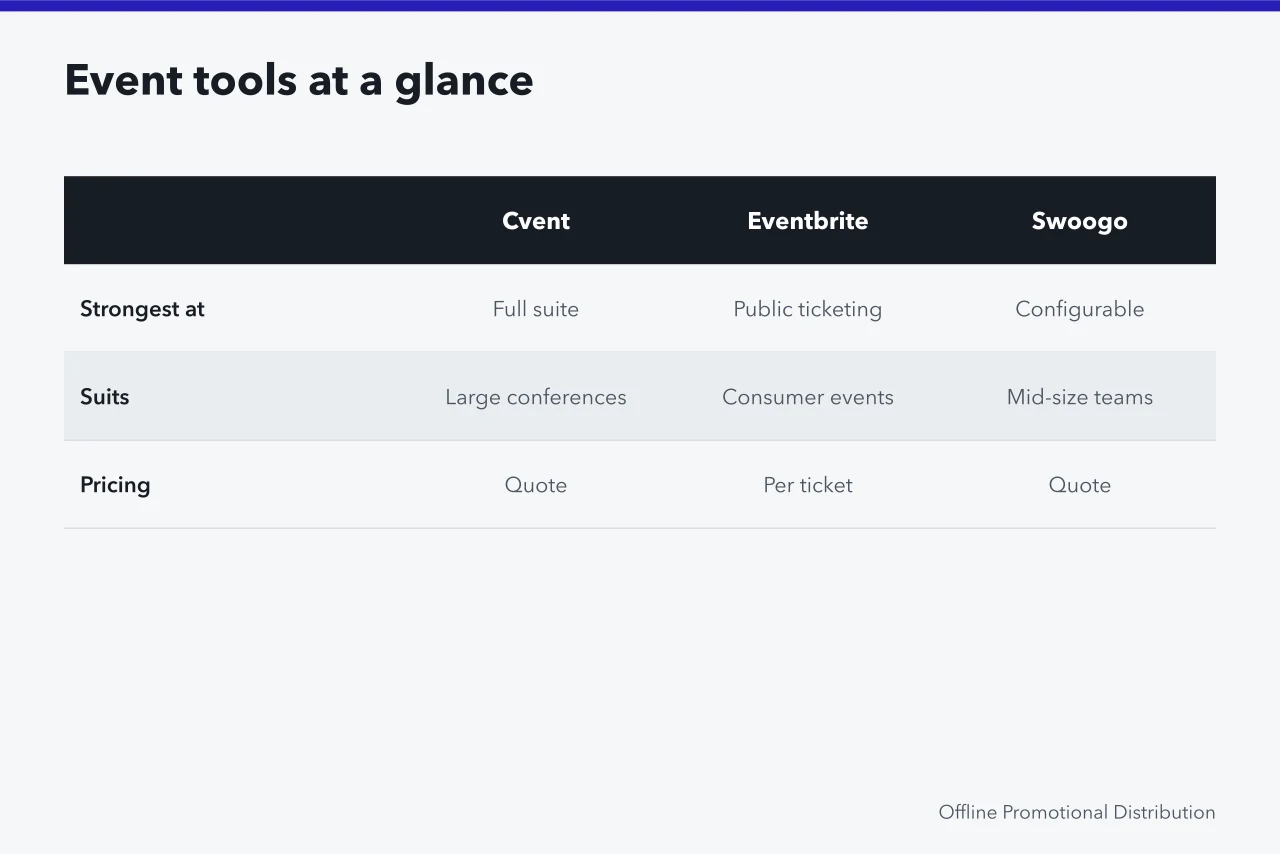
Eventbrite publishes per-ticket rates: 3.7% plus $1.79 per paid ticket, before card processing.
Cvent and Swoogo quote annually, and quotes typically start in the thousands, scaling with attendee count and modules.
Whova quotes per event, typically from the low hundreds to several thousand dollars, and the price moves with the calendar.
Put model, owner and variance in the same columns, which is what the conference budget template for Google Sheets does for a per-ticket line sitting beside a seat-based one.
The tools in the comparison table differ in their strengths and pricing models.
HubSpot list prices start near $20 per seat per month for Starter and climb steeply through Professional and Enterprise tiers. If it is part of the event stack, budget HubSpot as a separate marketing and follow-up seat license, not as registration or badging software. Seat pricing punishes a large field team.
Set contingency as a labeled band, and tie escalation clauses to published inflation data: the Consumer Price Index is the standard input for annual increases.
Two staff members can run the same stack and produce different estimates, so every line names an owner before signature.
A year-one discount often hides the steady-state price, and the second-year figure is the one the board approves.
Example: the software line on a 900-attendee conference
The conference organizer budgets walkthrough from estimate to final close shows why the line gets re-cut every time scope changes.
Software line on a 900-attendee conference
- Count the units each model charges fortickets sold, events run or seats used.
- Price the module mix against the published tier, not the demo build.
- Add laborbuild hours, on-site support and reconciliation at close.
- Set contingency as a band, and label it illustrative in the sheet.
- Write the owner and the renewal date beside every line.
Ask the vendor what invoice a refunded ticket produces, not just what the rate card says.
That answer decides whether the tech line reconciles cleanly at close.
A 900-attendee show carries more registration volume than a single-room workshop, and the estimate should say so.
The close, the accrual and the quiet period
Close is where the estimate meets invoices, and where a software line stops being a forecast and becomes evidence.
Book the software invoice against the accrual in the same pass as food and beverage, following the order set out in corporate event planning bookkeeping and cash flow basics.
Variance on the software line comes from three places: tickets sold above forecast, modules added mid-cycle and refunds that claw back per-ticket fees.
Speaker honoraria and travel reimbursements sit near the software line in the same budget, and IRS Form 1099-NEC reporting applies to contractor payments.
Write the variance explanation while the numbers are fresh; the general principles of budgeting treat that note as the point of the exercise.
Attention ends on a date, not a feeling. The budget is closed once the final invoice clears the accrual and the retention release is confirmed. The person who filed the variance note signs it off and dates it.
Common questions
Does every conference need a paid registration platform?
No. A single-room workshop can run on a spreadsheet and a card reader, and the conference AV cost estimator covers the neighboring line, which usually costs more than the registration software.
When should the tech line get another look?
Set a review date at renewal and name the change that would force an earlier check.
What has to be filed before the budget closes?
The final invoice, the accrual entry and the variance note, plus the export of registrant and ticket history.