
Guides
Conference Organizer Budgets: From First Estimate to Close
Conference organizer budgets move through five stages, from the first estimate to the close reconciled to the bank. Hybrid production is a second budget.
Conference Organizer Budgets: From First Estimate to Close
| Budget decision | Risky treatment | Better comparison | Control to use |
|---|---|---|---|
| Room and stream | Combine their figures | Separate cost centers | Name an owner for each path |
| Spending mix | Apply a generic split | Use line-level event drivers | Price by room, stream, and attendee where relevant |
| Speaker costs | Lump fees, travel, and meals together | Separate the cost and tax treatments | Collect the required form before payment |
| Contract taxes | Assume venue and catering are tax-free | Check state and local rates | Confirm before signing |
| Contingency | Choose a round number by habit | Match reserve to contract exposure | Review attrition and travel risks |
| Initial estimate | Use unsourced attendance or costs | Source assumptions and fix attendance | Record each source and check date |
| Approved version | Edit the approved file in place | Keep a dated, numbered baseline | Record changes as variances |
| Session delivery | Run without owners or stop rules | Rehearse and assign decisions | Reconcile invoices to allocation |
| Final close | Declare completion before matching costs | Match invoices and explain movement | Reconcile the total to the bank |
Room and stream: one allocation or two?
Budget hybrid delivery as a separate cost center, not as part of the room allocation. It has its own production, failure modes, and invoices, so give it a named owner; a shared owner can leave the stream with only leftover attention during the event.
Include a producer, platform license, redundant encoder, backup audio path, and chat moderator in the stream budget. Room and stream require separate crews; if one operator handles both, the stream gets only the attention left over. Assign two people, one to each path, rather than giving both jobs to one person.
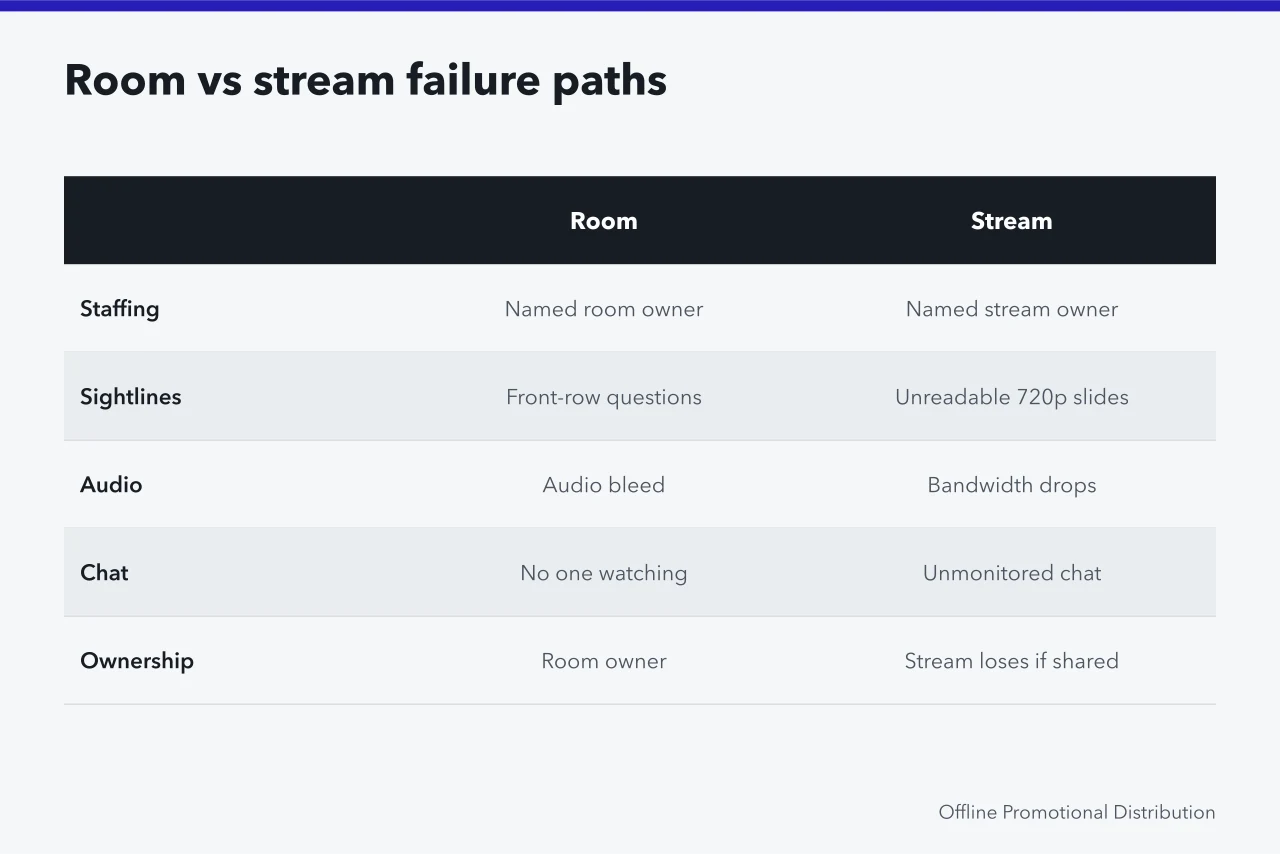
Hybrid delivery may widen reach, but it rarely lowers production cost: the license, second crew, redundant hardware, and chat moderator add expense. Price it as a separate production, keeping room and stream as distinct cost centers with named owners instead of folding those costs into a room-only budget.
Cost shares: fixed percentages or event drivers?
Use line-level drivers instead of a generic percentage split: venue and food and beverage usually form the largest block, and the venue contract influences the total more than a template.
Venue and F&B remain the biggest block, while AV and production rank second; that order is common, not a fixed formula.
Speaker travel and fees shift with geography and seniority. Event technology combines fixed and per-attendee charges linked to registration and the app, while contingency reflects policy and contract exposure. Compare food and beverage benchmarks with the per-person meal assumption rather than treating a published split as a reliable budget.
To sanity-check meal cost per person against household spending, the Bureau of Labor Statistics publishes food-away-from-home data in its Consumer Expenditure Survey. For production, price sound, lighting and staging by room and stream: adding a second room or stream drives costs fastest, so avoid one flat event-wide AV figure.
Speaker charges: one expense or separate treatments?
Keep speaker fees, travel reimbursements, meals, venue, and AV on separate lines: combining them hides distinct tax and reporting treatment. Collect the required form before payment, and flag meal deductions separately for CFO review rather than burying them in a general event expense.
Before paying, collect a signed Form W-9 from the speaker; the payer uses it to obtain the correct taxpayer identification number for information returns such as Form 1099-NEC. Report an independent speaker fee to the IRS on Form 1099-NEC, keeping fees and travel reimbursements separate.
Meal cost and meal deductibility are separate questions. US tax rules permit only a partial deduction for business meals and treat entertainment separately. Flag deductible F&B lines for CFO review so finance can identify them without reconstructing event spending; vendor 1099 reporting clarifies the reporting distinction.
Contract taxes: assume zero or verify?
Treat venue and catering costs as potentially taxable, not tax-free. In the US, contracts are usually taxed at state and local rates that vary by city. Confirm rates with the state department of revenue and local tax office before signing; check sales and hotel tax exposure against contract terms.
Contingency: standard habit or risk-linked reserve?
Choose a reserve in response to contract risk, not by habit. Roughly 5 to 12 percent is common for multi-day conferences, with more held when venue attrition terms or international speaker travel create greater exposure. Tie the amount to F&B minimums, speaker travel, and AV rather than a round number.
Refresh estimates by checking price movement through the Bureau of Labor Statistics CPI program. Force majeure and attrition clauses determine who pays when an event shrinks, so review them before choosing the reserve, not afterward. Compare contingency guidance with the event's F&B minimums, speaker travel, and AV exposure.
Starting figure: unsupported guess or sourced estimate?
Use a sourced rough order of magnitude before committing to a venue; an unsupported attendance or cost assumption can distort venue, food and beverage, badge counts, and later commitments. Record each source and its check date, and treat this estimate as planning input rather than permission to spend.
Set the estimate before signing a venue, using attendance, city, date window, and rough program length. Calculate cost per attendee by adding the venue minimum, F&B minimum, AV package, speaker travel, and event tech, then dividing by expected attendance. As contracts replace estimates, the result shifts, so every figure needs a source.
Include venue and F&B, AV and production, speaker travel and fees, event tech, and contingency. Speaker travel and technology licenses are common omissions. Fix attendance first because F&B minimums and badge counts derive from it; an unsourced estimate is difficult to defend later.
Approval record: editable copy or frozen baseline?
Keep the approved budget as a dated, numbered version instead of editing it in place. After signing the venue and setting the program, owners should approve every contracted or quoted line, then freeze the file before paying the first deposit. That preserved baseline makes later movement explainable.
Record every change against the frozen baseline as a variance, with a reason and approver. Contracts create committed costs, while posted invoices create actuals; measure both against the approved version, not a quietly revised copy. Preserve the sequence of estimate, approved budget, commitments, actuals, and final close.
A Google Sheets budget template can structure line items for review. The working sequence is estimate, approval, committed costs, actuals, and close. A line-by-line reconciliation supports that handoff, but it does not replace the approved baseline or turn revised figures into approval.
Session delivery: informal operation or controlled run?
Run hybrid sessions against the approved allocation, with named owners, stop rules, and rehearsed failure paths. A 45-minute breakout sent to a room and stream can use a $9,000 production allocation from approved AV and stream lines. The checks connect timing, failover, payment, delivery, and close.
| Control | Owner | Stop rule |
|---|---|---|
| Publish the run sheet and freeze timing | Program lead | Any timing change after approval |
| Rehearse platform failover | Stream producer | Fallback cannot carry audio and slides |
| Confirm speaker contract and payment terms | Program lead | No signed contract on file |
| Run the session | Room and stream leads | Either path loses core audio |
| Reconcile the invoice against the allocation | Finance | Variance above 10 percent unexplained |
These five checks describe one session, not a staffing formula. Scale the pattern rather than the headcount, while keeping the allocation tied to approved AV and stream lines. Timing, failover, speaker payment, delivery, and invoice reconciliation remain connected to named owners and the budget allocation.
Final close: declared complete or reconciled?
Close each line only after its invoice matches the purchase order, any variance is explained, the remaining balance is released, and the total reconciles to the bank statement. Unmatched invoices mean the budget is still live; declaring it filed can leave unexplained variances, unreleased balances, or duplicate costs.
In the final month, compare committed, actual, and forecast weekly on one page; variance reporting supports this review. Committed costs are signed but not invoiced; actuals are invoiced and posted; forecast is judgment about what remains. Recording a deposit as both committed and actual is a classic double count.
Cash flow may matter more than the total because deposits can precede registration revenue by months, so show the budget month by month, not only as a final amount. Close only when every line is documented, variances are explained, and the resulting total reconciles with the bank; keep controls consistent from estimate to reconciliation.
If any line remains open, keep the file live rather than filed. Attendance remains the first number to fix because F&B minimums and badge counts derive from it. Apply the same controls from rough estimate through final reconciliation to every line, rather than switching standards at each handoff.