Guides
Corporate Event Planning Business: Budgeting US-Canada Taxes & Customs
Corporate event planning business budgets for US-Canada conferences need withholding, customs entries, import taxes, currency, and license checks.
What to take away
- A corporate event planning business running joint US-Canada conferences must budget for currency swings, customs brokerage, and withholding tax on cross-border payments.
- Shipped event gear needs a carnet or formal customs entry, and both directions carry paperwork that costs money and time.
- Speaker and vendor payments face US withholding unless a tax treaty reduces the rate, and the paperwork must be filed before payment.
- USMCA helps goods that qualify, but conference equipment still needs an export or import license check.
- A joint conference budget should separate US dollar and Canadian dollar lines, then add 8 to 15 percent for cross-border friction.
What changes when a conference crosses the US-Canada border
A conference that stays inside one country has one tax system, one currency, and one customs regime. A joint conference between the United States and Canada has two of each. That doubles the paperwork and adds costs that never appear on a domestic budget.
The first change is currency. Your contracts may be signed in US dollars, but venue deposits, union labor, and local vendors in Canada bill in Canadian dollars. The exchange rate on the day you pay is not the rate on the day you signed. That gap is a budget line.
The second change is customs. Laptops, microphones, stage sets, and printed materials that cross the border are goods entering the United States or Canada. They may be duty-free, but they are not paperwork-free. A missing form can hold a shipment at the border while your opening session waits.
The third change is tax. A US organizer paying a Canadian speaker, or a Canadian organizer paying a US vendor, may have to withhold tax and send it to the other country's revenue agency. The rate depends on residency and on the tax treaty.
Each of these three changes hits a different part of the budget. Currency hits cash flow. Customs hits logistics and contingency. Tax hits speaker fees and vendor contracts. If you plan a joint conference without all three, your margin will absorb the difference.
A useful starting point is to treat the border itself as a cost center. Give it its own line in the budget, not a note in a spreadsheet cell. That forces you to estimate brokerage, carnets, withholding, and exchange fees before you sign venue contracts.
Currency exchange and how it moves conference organizer budgets
Currency exchange budgeting starts with knowing which costs are in which currency. Venue rental, catering, and local labor in Canada are usually billed in Canadian dollars. Speaker fees, software subscriptions, and US-based vendors are usually billed in US dollars.
Currency swing on CAD 400,000
- 3%currency swing
- CAD 12,000cost impact
- 1-3%bank margin
- 3-5%contingency of cross-border spend
USD vs CAD cost split
USD costs
- Venue rental
- Catering
- Local labor
- Speaker fees
- USD
- Software subscriptions
- USD
- US-based vendors
- USD
CAD costs
- Venue rental
- CAD
- Catering
- CAD
- Local labor
- CAD
- Speaker fees
- Software subscriptions
- US-based vendors
Build two columns in your budget: one for USD, one for CAD. Do not convert everything to one currency at a single rate. Instead, assign each cost to the currency you will actually pay, then add a conversion line for the amounts you must move across.
Exchange rates move between contract signing and payment. A venue deposit paid six months before the event can cost more or less than the rate you used to price registration. If you price registration in USD and pay costs in CAD, a stronger USD helps you, and a weaker USD hurts.
Banks and payment processors add a margin above the published rate. That margin is often 1 to 3 percent. Add it to every cross-border payment, including wire fees and card processing fees.
For a conference with a CAD 400,000 cost base, a 3 percent currency swing is CAD 12,000. That is real money, and it is not covered by a line item that says miscellaneous.
Hedging is possible but rarely worth it for a single event. A simpler approach is to hold a currency contingency of 3 to 5 percent of cross-border spend, and to pay Canadian vendors from a Canadian dollar account when you can.
Your bookkeeping and cash flow should track each currency separately, and the strongest markets for corporate event planning are the ones where that discipline pays off. Do not let a bookkeeping system net CAD and USD into one balance without a clear conversion trail. Auditors and tax agencies in both the United States and Canada will ask.
Registration pricing is the other side of the coin. If you charge US attendees in USD and Canadian attendees in CAD, you have created two revenue streams with two exchange exposures. Decide which currency carries the risk, and state it in your registration terms.
Customs paperwork for shipped event gear and ATA carnets
Customs paperwork for shipped event gear is the part of cross-border planning that surprises organizers most. The goods are temporary. The border does not care. They are still imports and exports.
Customs prep for event gear
- Confirm which gear is temporary and which is a giveaway
- Apply for an ATA carnet
- Label every case with event name and carnet number
- Build a packing list matching the carnet line by line
- Count cables, adapters, and spare parts
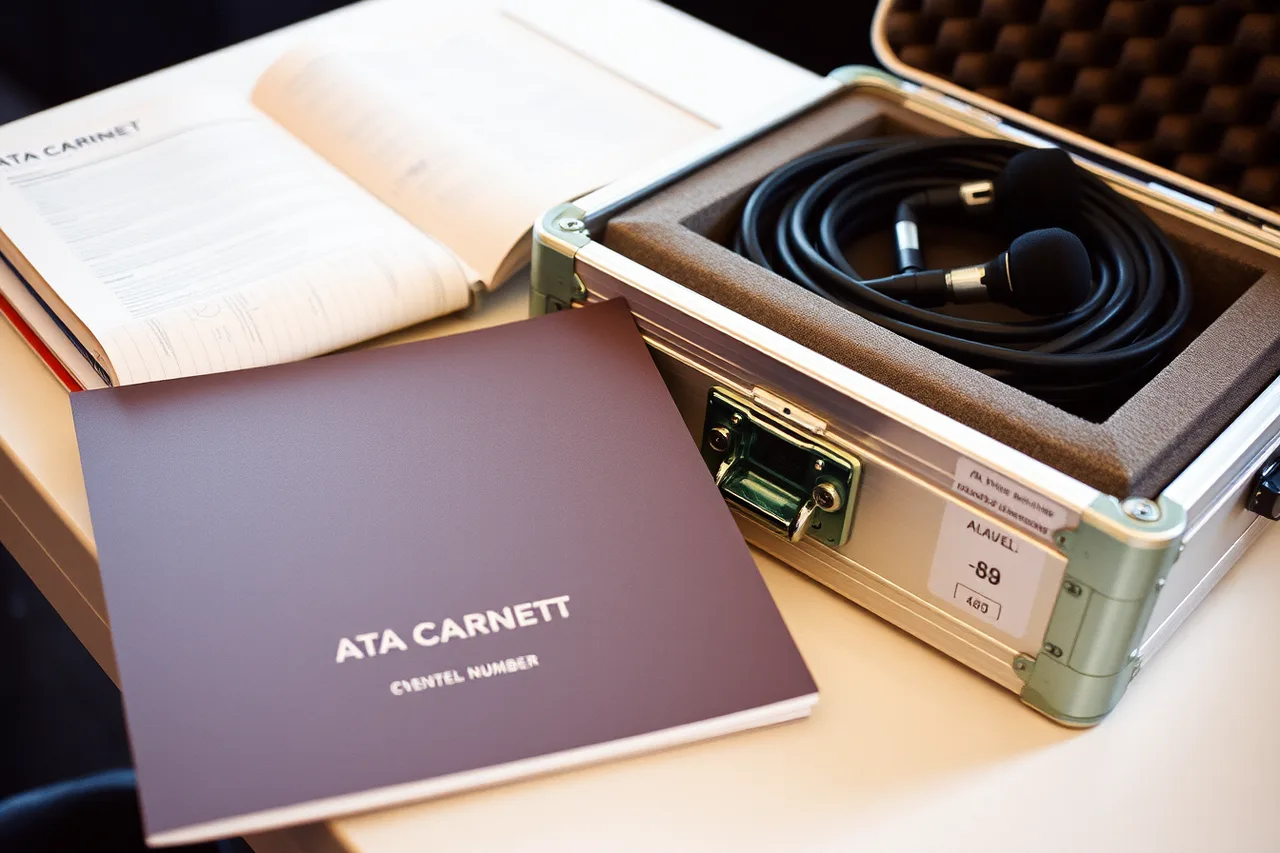
An ATA carnet is a passport for goods. It lets you bring professional equipment into the United States or Canada temporarily without paying duties or taxes, provided the goods leave again. The carnet must list every item, and the list must match what arrives.
Not every shipment qualifies for a carnet. Giveaways, printed brochures, and items you intend to leave behind are not temporary. They may need a formal customs entry and may owe duty or tax.
Use U.S. Customs and Border Protection (CBP) for U.S. entries and the Canada Border Services Agency (CBSA) for Canadian entries. A U.S. formal entry uses CBP Form 7501, Entry Summary; Canada uses a Commercial Accounting Declaration (CAD) through CBSA’s CARM system for import accounting. Ask a customs broker which filing applies to the shipment, and budget for brokerage, duties, and import taxes separately, including Canadian import GST/HST.
If you ship without a carnet, you will likely need a customs broker. A broker prepares the entry, posts any bond, and clears the shipment. Broker fees for a conference shipment can run from a few hundred to a few thousand dollars, depending on value and complexity.
Label every case with the event name, the carnet number, and a contact who can answer border questions. A case with no paperwork is a case that sits in a warehouse while your team sets up a stage.
Build a packing list that matches the carnet line by line. Count cables, adapters, and spare parts. If the carnet says 12 microphones and the case holds 13, you have a problem at the border.
- Confirm which gear is temporary and which is a giveaway
- Apply for an ATA carnet through a US or Canadian chamber of commerce
- Match the carnet list to the packing list, item by item
- Book a customs broker for both directions
- Add brokerage and carnet fees to the logistics budget
- Name a border contact who can respond within one hour
- Plan a buffer day before setup for customs clearance
Your legal and insurance guide should cover what happens if customs seizes or delays goods. Standard event insurance may not pay for a delayed shipment that forces a schedule change.
US-Canada tax treaty rules and withholding for speakers and vendors
US-Canada tax treaty withholding rules decide how much tax you withhold when you pay a speaker or vendor across the border. The default under US law is 30 percent withholding on payments to nonresident aliens.
Withholding on cross-border payees
Has the payee provided a W-8BEN or W-8BEN-E?
Treaty rate may apply, often zero
Withhold at the default 30 percent
The IRS explains this in Publication 515 (2026), Withholding of Tax on Nonresident Aliens and Foreign Entities | Internal Revenue Service. If you pay a Canadian speaker who is a nonresident alien, you may have to withhold 30 percent and send it to the IRS.
The US-Canada tax treaty can reduce that rate, often to zero for certain business income or personal services. But the treaty does not apply automatically. The payee must provide the right form, usually a W-8BEN or W-8BEN-E, before you pay.
If the form is missing, you withhold at the default rate. The speaker then has to file a US tax return to claim a refund. That is a bad experience, and it can damage your relationship with a repeat speaker.
On the Canadian side, a payer generally withholds 15 percent under Regulation 105 of Canada’s Income Tax Regulations on payments to a nonresident for services performed in Canada, unless the Canada Revenue Agency (CRA) approves a waiver or reduction. Apply to the CRA using Form R105 for a Regulation 105 waiver or reduction. A treaty-benefit declaration may also be needed: Form NR301 for an individual, NR302 for a partnership, or NR303 for a hybrid entity.
For vendors, the question is whether the payment is for services performed in the country or for goods. Goods are generally not subject to withholding. Services performed in the country often are. A booth builder who sends a crew to install in Toronto is providing services in Canada.
The IRS provides broader guidance for International taxpayers | Internal Revenue Service, including residency and treaty questions. Read it before you sign a cross-border speaker contract, not after.
Put a clause in every cross-border contract that says who bears withholding. If the contract says the fee is USD 10,000 net, and withholding applies, you may owe the tax on top of the fee. That is a budget surprise you can avoid with one sentence.
Collect tax forms during contracting, not during payment week. A speaker who has already flown home is harder to chase for a W-8BEN.
USMCA and trade agreement provisions relevant to conference logistics
USMCA is the trade agreement that replaced NAFTA. It governs most goods moving between the United States, Canada, and Mexico. For conference logistics, it matters because it sets the rules for duty-free treatment.
USMCA origin qualification
May qualify
- Stage set built in US
- Yes
- Set built in Asia
- Duty-free treatment
- Possible
- Customs paperwork
- Still required
May not qualify
- Stage set built in US
- Set built in Asia
- No
- Duty-free treatment
- Customs paperwork
- Still required
To claim USMCA benefits, goods must meet rules of origin. That means they must be made in a USMCA country, or contain enough USMCA content. A stage set built in the United States and shipped to Canada may qualify. A set built in Asia may not.
The Canada - Trade Agreements guide from the US Commercial Service explains how these agreements affect US businesses selling and shipping to Canada. It is a starting point for understanding which rules apply to your shipment.
For conference gear, USMCA can reduce or eliminate duty. It does not remove the need for customs paperwork. You still declare the goods, and you still need a carnet or entry.
USMCA does not prescribe a standard certification form. A certification may appear on an invoice or another document, but it must include the agreement’s required information: the certifier, exporter, producer, and importer if known; a description of the goods; their tariff classification; the origin criterion; any applicable blanket period; and the certifier’s signature and date. Keep the certification with the shipping papers.
USMCA also covers services and temporary entry for business persons. That can matter for your staff and crew who cross the border to set up an event between the United States and Canada. The rules are specific about who qualifies and for how long.
Do not assume that USMCA covers everything. Printed materials, food samples, and giveaways may fall outside the duty-free treatment or may have their own rules. Check each category before you ship.
A trade agreement is not a substitute for a customs broker. It is a set of rules that a broker can use to lower your duty bill. Give your broker the origin information early.
Import and export license steps for event equipment
Most conference equipment does not need an import or export license. But some does, and the penalties for shipping without one are severe. The first step is to check whether your goods appear on a control list.
For US exports, How to get an export license or permit | USAGov explains the application process and which agencies handle it. Encryption hardware, certain electronics, and dual-use items are common examples that may need a license.
For imports into the United States, How to get an import license or permit | USAGov covers the permit steps and the agencies involved. Food, plants, animals, and some radio equipment face additional import rules.
Here are the steps to follow for event equipment moving between the United States and Canada:
- Inventory the equipment, recording its model, origin, destination, value, and whether it will return or remain in the destination country.
- Decide whether temporary equipment will travel under an ATA carnet or require a formal import entry, and identify the importer of record.
- For U.S.-origin items, check the Commerce Control List under the Export Administration Regulations and identify the applicable classification, such as an ECCN or EAR99. For defense articles, check the U.S. Munitions List under ITAR, administered by the Directorate of Defense Trade Controls (DDTC).
- For controlled Canadian exports, check Canada’s Export Control List and requirements administered by Global Affairs Canada.
- Obtain any required export license or permit from the Bureau of Industry and Security (BIS), DDTC, or Global Affairs Canada, as applicable, before shipment.
- For radio equipment, check U.S. Federal Communications Commission (FCC) authorization and Canadian Innovation, Science and Economic Development Canada (ISED) certification and frequency requirements.
- Have a broker confirm the applicable CBP or CBSA entry paperwork; give the carrier advance notice of lithium batteries and any required shipping documents.
Import and export license steps
- List every item that will cross the border
- Check each item against US and Canadian control lists
- Apply for any required license or permit early
- Decide between ATA carnet or formal customs entry
- Engage customs brokers in both countries
- File paperwork, keep copies, carry with shipment
- Reconcile the goods when they return
Radio equipment deserves special attention. Wireless microphones and transmitters operate on frequencies that are regulated in both countries. A device that is legal in the United States may not be legal in Canada, and vice versa.
Batteries and lithium cells have their own shipping rules. They may be restricted on certain carriers and may require special documentation. Check with your freight forwarder before you pack them.
If you are unsure whether an item needs a license, ask the broker or the relevant agency. A short delay for an answer is cheaper than a seizure at the border.
Budget model: a joint US-Canada conference
Here is a worked example. A US organizer runs a two-day conference in Toronto for 600 attendees, with a US-based speaker roster and a Canadian venue. The total budget is USD 500,000.
The organizer splits costs into three buckets: US dollar costs, Canadian dollar costs, and cross-border friction. The friction bucket is the one most organizers forget.
Budget model
| Line item | Currency | Amount | Notes |
|---|---|---|---|
| Venue and catering | CAD | 220,000 | Billed in Canadian dollars |
| Speaker fees | USD | 90,000 | Some paid to Canadian residents |
| Audio visual and staging | CAD | 70,000 | Local vendor, local crew |
| Travel and hotels | USD | 60,000 | Booked in US dollars |
| Marketing and registration | USD | 30,000 | US-based platforms |
| Customs and brokerage | USD | 8,000 | Carnet, broker, both directions |
| Currency contingency | CAD | 12,000 | 5 percent of CAD spend |
| Withholding tax reserve | USD | 9,000 | Treaty forms pending |
| Total | Mixed | 499,000 | Before registration revenue |
The currency contingency is not a guess. It is 5 percent of the CAD 240,000 in cross-border spend, held for rate movement and bank margins. If the rate moves in your favor, the line becomes profit.
The withholding tax reserve covers the risk that a speaker or vendor does not file a treaty form in time. If the forms arrive, the reserve is released. If they do not, you have the cash to remit the tax without touching your margin.
Customs and brokerage at USD 8,000 covers an ATA carnet, a broker in each country, and a buffer for a delayed shipment. For a conference with a large stage set, this line can be higher.
Keep duty and import taxes separate from the customs-and-brokerage line. For Canadian costs, budget for GST/HST on taxable purchases and applicable imports, and QST where relevant in Quebec. For the Toronto example, Ontario HST is relevant, not QST. Whether a foreign organizer must register or can recover tax depends on its circumstances and eligibility. Eligible foreign convention organizers may be able to claim a GST/HST rebate through the CRA’s Foreign Convention and Tour Incentive Program using Form GST386, Rebate Application for Conventions.
Notice that the budget does not convert everything to one currency. It keeps CAD costs in CAD and USD costs in USD. That makes the exchange exposure visible instead of hiding it inside a single total.
Your quote template should show clients how cross-border costs are calculated. A client who sees a currency contingency line is less likely to argue about it later.
For owners still planning their first cross-border event, the startup costs of a US-Canada practice include legal review, broker relationships, and a Canadian dollar account. These are fixed costs that pay back over multiple events.
Finally, review your prices and margins after the event closes. Cross-border conferences can carry higher margins, but only if the friction costs are priced in from the start. If they are not, the border takes the profit.